


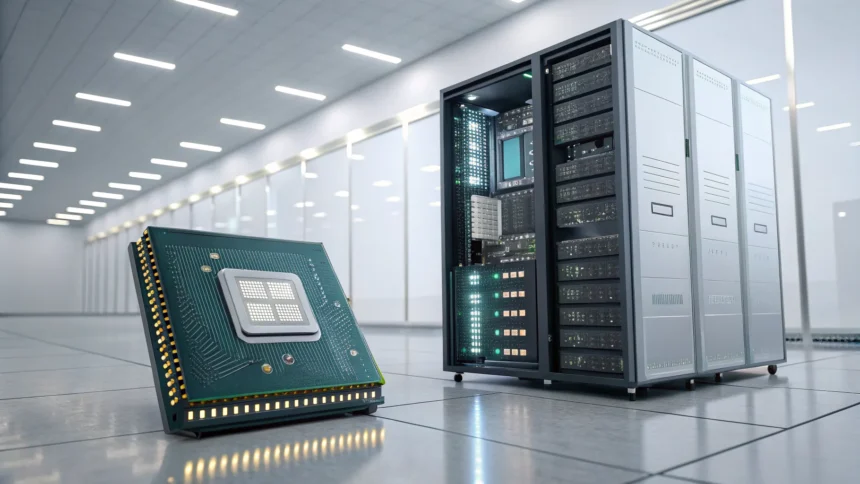
Alibaba announced new upgrades to its artificial intelligence stack, signaling a push to sharpen its technology and meet rising demand from business customers. The company said it is rolling out a more powerful chip and a new large language model to strengthen its cloud services and developer tools. The move reflects growing pressure on major tech firms to scale AI while managing costs and access to computing power.
“Alibaba announced updates to its AI offerings, including a more powerful chip and a new large language model.”
Why This Matters Now
AI spending is climbing as companies automate support, speed up software work, and build new search and analytics tools. Stronger chips can lower the cost to train and run models. New language models promise better accuracy and safer responses. Together, these steps can improve cloud services and draw in more developers.
China’s tech sector is also racing to match advances seen in the United States and Europe. Firms face supply limits for high-end semiconductors and must improve homegrown options. A more capable in-house chip could reduce exposure to import risks. It may also give Alibaba more control over pricing and performance for its cloud customers.
What The Upgrades Could Change
The chip update suggests higher throughput and improved energy use, two factors that drive the cost of AI. Faster chips can shorten training cycles and serve more users for the same power budget. A new language model can bring better reasoning, coding help, and support for longer documents. It could also improve tools for search, chat, and content moderation inside Alibaba’s platforms.
- Stronger chip: potential gains in speed, efficiency, and cost control.
- New language model: improved accuracy, safety filters, and multilingual support.
- Cloud impact: better value for enterprises building AI services.
Industry Context And Constraints
Global firms are investing in custom silicon to power AI at scale. Proprietary chips help align hardware with model needs and reduce reliance on third parties. Yet success depends on software support and a deep pool of developers. Without strong tooling, even powerful chips can struggle to gain traction.
Language models face their own hurdles. Training data must be high quality and diverse. Safety and compliance systems need constant updates. Customers want clear pricing and benchmarks that match real workloads. Many buyers now ask for proofs of efficiency, not just raw capability.
Signals From Users And Developers
Enterprises will watch for evidence that the chip reduces inference costs, a key expense for customer-facing apps. They will also look for stable service-level agreements, reliable latencies, and security certifications. Developers often seek rich APIs, fine-tuning options, and strong observability to track model quality over time.
Small and mid-size teams may welcome tiered access and credits to test the new model. They also need clear content rules and tools to filter harmful outputs. Education on prompt design and evaluation is in high demand as teams move pilots into production.
What To Watch Next
Key details will shape how the market reacts. Pricing and availability will set the pace of adoption. Benchmarks on common tasks, such as coding, retrieval, and long-context summarization, will show whether the model is competitive. Hardware integration with popular frameworks will indicate how quickly customers can migrate workloads.
Partnerships with software vendors and system integrators could speed deployment across retail, finance, and logistics. Clear migration paths from older models and hardware will matter for existing Alibaba Cloud users. Transparent reporting on power use and emissions may also weigh on procurement choices as firms track AI’s energy footprint.
Alibaba’s announcement points to steady progress on two fronts that matter for modern AI: compute and models. The outcome will depend on execution, credibility on benchmarks, and the strength of the developer ecosystem. If the chip and model deliver lower costs and better quality at scale, Alibaba could gain ground in cloud AI. If not, buyers may stick with familiar stacks while they wait for more proof.