


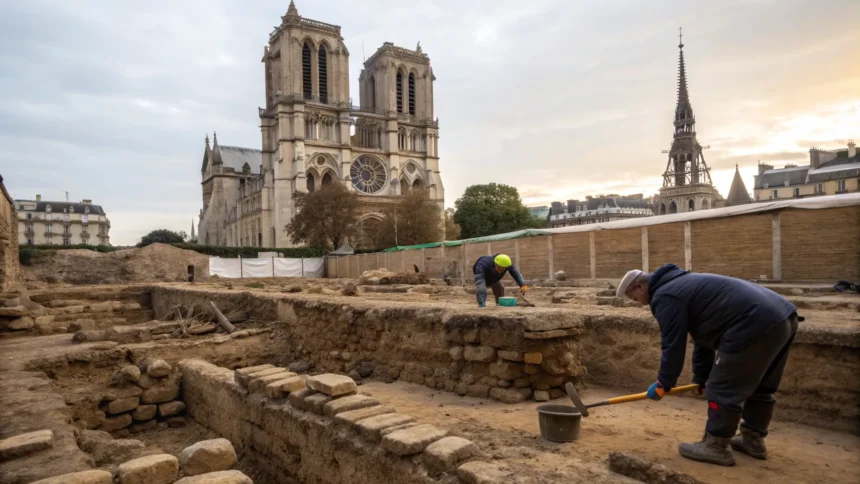
Archaeologists in Paris have opened new trenches beneath Notre Dame Cathedral, seeking traces of Roman-era life buried for nearly 2,000 years. The work, taking place on the cathedral’s parvis and interior areas cleared for restoration, aims to document ancient remains before crews finish rebuilding the fire-damaged landmark.
The dig brings together French heritage officials, city archaeologists, and restoration teams on a tight schedule. Their goal is to recover evidence of early Paris, once known as Lutetia, while protecting the cathedral’s fragile structure and meeting reopening targets.
What Investigators Hope to Find
Teams are targeting layers that could include foundations of earlier churches, fragments of Roman streets, and domestic material from antiquity. These clues can refine the timeline of settlement on the Île de la Cité, a core site in the city’s long history.
“Archaeologists are digging beneath Notre Dame Cathedral to explore as far back as Roman Paris from 2,000 years ago.”
Finds may range from construction stones and roof tiles to ceramics, coins, and human burials. Even small shards can date activity and reveal trade links in the old city.
Why This Matters Now
The 2019 fire that destroyed the cathedral’s roof and spire set off one of Europe’s largest restoration projects. Before heavy equipment can return, archaeologists have a rare chance to examine layers long sealed under pavement and floors. Emergency stabilization created work zones that are now being used for research.
Paris has a record of discoveries near Notre Dame. Past excavations on the forecourt uncovered Roman walls and medieval structures, later displayed in the Archaeological Crypt. In 2022, teams found a lead sarcophagus and painted fragments while preparing the site for spire reconstruction. This history raises hopes that current trenches will produce more evidence from the city’s earliest centuries.
Balancing Science and Restoration
The investigation must move quickly to stay aligned with the cathedral’s reopening plan. Heritage experts say the approach follows a standard rescue model: excavate, record, and preserve what is most at risk, then hand the space back to builders.
- Archaeologists map and photograph each layer before removal.
- Finds are cataloged, stabilized, and sent to labs for study.
- Results inform site protection and future displays.
The tight timeline raises concerns about missing fragile traces. Specialists counter that careful sampling and selective deep trenches can capture key data while keeping the project on track.
What the Past Can Reveal
Roman Paris grew along the Seine as a river hub linking northern Gaul with the rest of the empire. Materials from under Notre Dame could show how elites built near the water, how craftspeople worked, and how later Christian builders reused older stone. If early church foundations appear, they could clarify when worship shifted to this island and how the medieval cathedral incorporated earlier sacred ground.
Comparisons to other French cities, such as Lyon and Reims, suggest that urban cores often hold stacked layers of Roman, late antique, and medieval activity. Similar patterns at Notre Dame would strengthen this view and help refine dates for Paris’s growth.
What Comes Next
Once trenches close, attention will move to laboratory analysis. Specialists will date ceramics, study mortar composition, and examine any organic remains. Reports typically follow within months, with a fuller synthesis after peer review.
Officials have indicated that significant discoveries could be interpreted for the public through the on-site crypt or temporary exhibits. Digital models of the trenches may also be released to explain the sequence of layers beneath the cathedral.
The renewed dig under Notre Dame offers a clear chance to connect the modern city with its Roman roots. The results could sharpen the story of Paris’s birth on the Seine and guide future conservation on the cathedral island. As restoration advances, the next updates to watch include any evidence of early sacred structures, new dates for Roman activity on the site, and plans for sharing the finds with visitors once the doors reopen.