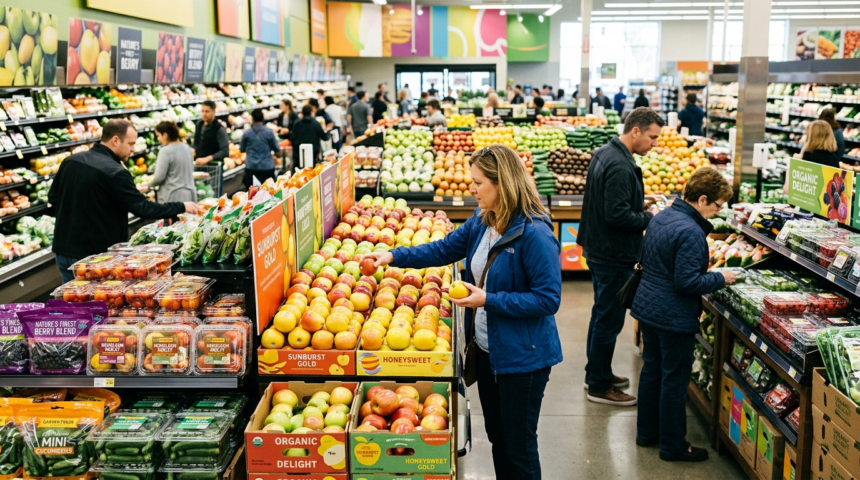
The produce aisle is entering a new phase as named fruits and vegetables compete for shoppers’ attention and grocery budgets.
Premium apples, grapes, oranges, and tomatoes now carry memorable names, higher prices, and legal protections. Rutgers University is joining that race with Scarlet Sunrise, a grape tomato developed in New Jersey.
NPR’s Planet Money and Dan Pashman, host of The Sporkful food podcast, examined the tomato’s development. Their reporting also raised a larger economic question: How many branded varieties can the produce market support?
Produce Starts Acting Like Packaged Food
Fresh produce was once sold mainly by broad type. Shoppers chose among familiar labels such as cherry tomatoes, grape tomatoes, red apples, or green grapes.
That system has changed. The Honeycrisp apple, Cotton Candy grape, and Cuties mandarin have become recognizable products. Their names help distinguish them from nearby alternatives.
“They stand out. They cost more. They have branding and sometimes trademarks and patent-ish kinds of protections.”
The shift gives growers and sellers a way to compete on taste, identity, and consistency rather than price alone. A distinct name can also help customers remember a product after leaving the store.
The tomato section now reflects the same strategy. Sugar Bombs, Flavor Bombs, Lolli Bombs, and Sprinkles compete with standard cherry and grape tomatoes.
Rutgers Enters a Crowded Tomato Market
Scarlet Sunrise is an up-and-coming grape tomato from Rutgers University. Its university connection illustrates the long research process behind many new produce varieties.
Plant developers select traits over time, seeking a useful mix of flavor, appearance, yield, shelf life, and resistance to crop problems. A tomato must please shoppers while also meeting the needs of growers, distributors, and grocers.
Brand identity adds another layer. A successful variety needs more than good flavor. It must earn shelf space and persuade shoppers to pay attention in a section filled with established names.
- A memorable name can separate a variety from ordinary produce.
- Legal protections may help developers recover research costs.
- Premium pricing can benefit growers if demand remains strong.
- Too many similar products may confuse shoppers.
Economists See a Risk of Saturation
Cornell agricultural economist Miguel Gomez considered whether branded fruits and vegetables are nearing market saturation. That point arrives when new products struggle to find enough unmet demand.
The strategy can benefit consumers by encouraging better flavor and more choice. It can also support research into varieties that perform well from the farm through retail distribution.
However, a growing number of premium names can make comparison harder. Customers must judge whether a branded tomato offers enough added value to justify its price.
Retail space creates another limit. Produce departments cannot stock every new variety, so stores must decide which names deserve a place. Products with weak sales may disappear even if their agricultural traits are strong.
University Breeding Plays a Key Role
Public universities have long helped develop commercial crops. Washington State University, for example, developed the Cosmic Crisp apple. NPR issued an August 31, 2026, correction after previously attributing it to the University of Washington.
Such programs connect agricultural science with consumer demand. Yet branded university varieties also show how public research now operates within markets shaped by licensing, promotion, and premium pricing.
Scarlet Sunrise will face a practical test at the grocery shelf. Its future depends on taste, farm performance, distribution, price, and whether shoppers remember its name.
The larger trend is clear: produce is no longer marketed only as a basic commodity. The next question is whether another branded tomato can build lasting demand, or whether the aisle has reached its limit.