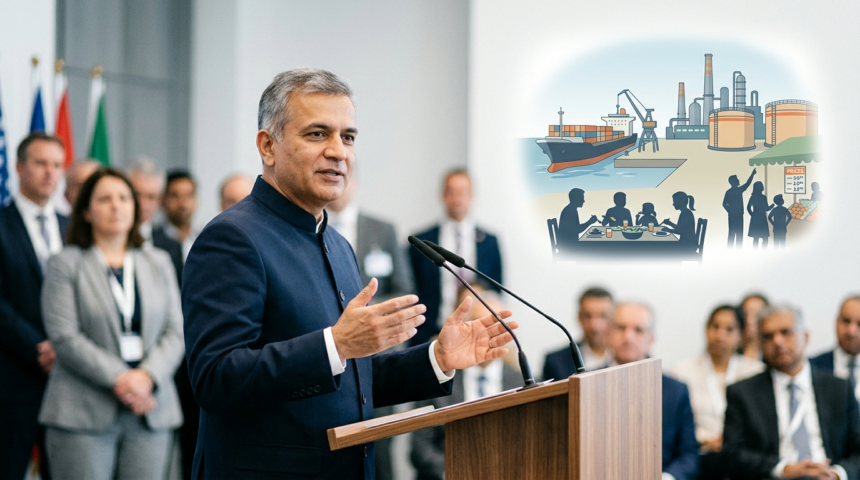
India will keep its Russia policy tied to consumer interests rather than demands for a simple geopolitical choice, External Affairs Minister S. Jaishankar has said.
Asked whether New Delhi could change its position on Moscow, Jaishankar rejected an “on or off” view of foreign policy. He said the government would act according to what best serves Indian consumers.
The response signals continuity in India’s pragmatic approach to Russia. It also suggests that affordability, supply security and domestic economic needs will remain central to future decisions.
India Rejects a Simple Choice
Jaishankar’s wording challenged the idea that relations between countries can be treated like a switch. India has long argued that its diplomatic ties should be judged on national interests rather than fixed political blocs.
Jaishankar rejected an “on or off” formulation and said the government would do what is best for the Indian consumer.
That position allows New Delhi to work with different partners on separate issues. India may cooperate with one country on energy while working with others on trade, defense or technology.
The statement did not set out conditions that could lead to a policy change. It also did not identify a timetable for reviewing ties with Russia. Instead, it offered a standard for decisions: their effect on Indian consumers.
Consumer Costs Shape Foreign Policy
Referring to consumers places household finances near the center of the debate. Energy prices affect transport, food production, manufacturing and inflation. A sharp rise can put pressure on families and government budgets.
India’s policy therefore involves more than diplomatic alignment. Officials must weigh several practical questions:
- Whether supplies remain dependable and affordable
- How purchasing choices affect inflation at home
- Whether alternative suppliers can meet demand
- How decisions may affect other international partnerships
This reasoning supports flexibility, but it also brings scrutiny. Partners seeking a firmer Indian position may view consumer welfare as only one part of a wider security and diplomatic dispute.
India’s approach, however, treats economic stability as a major national interest. Jaishankar’s answer suggests the government does not accept that maintaining one relationship requires ending another.
A Policy of Strategic Flexibility
India and Russia have maintained close ties over many years, including cooperation in defense and energy. At the same time, India has expanded relations with the United States, Europe and other partners.
Balancing those relationships can give New Delhi room to act independently. It can also create friction when partner governments expect clearer alignment during an international crisis.
Jaishankar’s remarks reflect a broader principle in Indian diplomacy: policy choices may change as circumstances change, but not simply because outside observers frame the issue as a yes-or-no test.
The key question now is how India applies the consumer-interest standard if prices, supplies or diplomatic costs shift. Future purchasing decisions will show how the government balances affordable goods with pressure from international partners.
For now, Jaishankar has indicated that India’s Russia policy is neither unconditional nor easily reversed. It will be measured against practical benefits at home, with the Indian consumer presented as the government’s primary concern.