


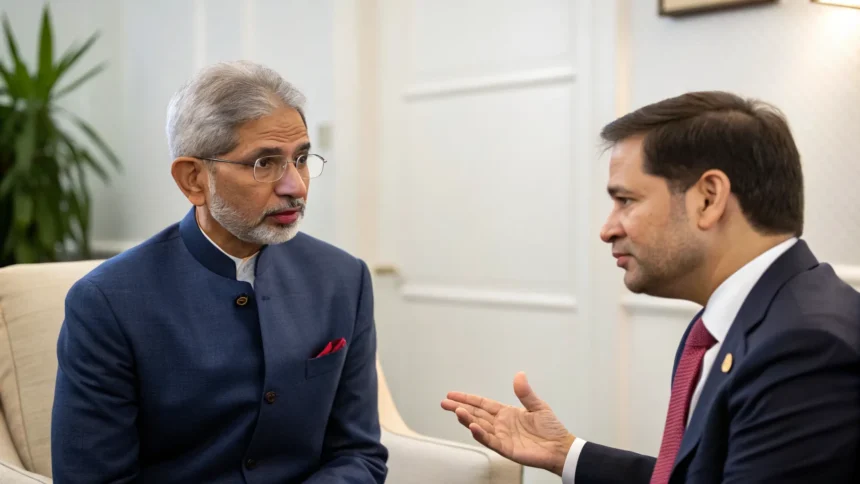
India’s External Affairs Minister Subrahmanyam Jaishankar drew a direct link between U.S. and Indian priorities in a recent exchange with U.S. Senator Marco Rubio, stating that New Delhi’s policy is guided by national interest. The comment framed India’s foreign and economic choices as aligned with a clear “country first” principle, echoing longstanding themes in both capitals and signaling how India plans to navigate a tense global environment.
“Like America First, we believe in India First,” Jaishankar told Rubio.
The remark comes as India balances its ties with the United States, manages a difficult relationship with China, and continues a legacy defense relationship with Russia. It also reflects India’s push for supply chain resilience, domestic manufacturing, and technology partnerships, while insisting on policy space to secure its own priorities.
What the Statement Signals
By invoking “America First,” a slogan often associated with U.S. sovereignty and economic self-reliance, Jaishankar placed India’s approach in familiar terms for Washington. The message suggests New Delhi will cooperate closely with the United States, but will judge each step by how it serves Indian interests on security, trade, and technology.
Policy analysts note that this framing supports a pragmatic style of diplomacy known in India as strategic autonomy. It emphasizes flexible coalitions, issue-by-issue cooperation, and diversification of partners. It also prepares domestic audiences for choices that may not always align with any single bloc.
Policy Roots of ‘India First’
India’s leaders have stressed self-reliance and resilience in recent years, from the “Atmanirbhar Bharat” manufacturing push to efforts to localize defense production and attract semiconductor and electronics investments. The goal is to reduce exposure to fragile supply chains and to upgrade capacity at home.
Security concerns reinforce this outlook. India has faced deadly clashes along the Line of Actual Control with China and continues to modernize its military. At the same time, historical procurement ties with Russia make a rapid shift complex, even as India deepens exercises, logistics agreements, and defense co-development with the United States and partners in the Indo-Pacific.
Implications for U.S.–India Relations
For Washington, the “India First” message is not a rejection, but a guide to how cooperation can grow. The two sides are pursuing defense technology initiatives, critical minerals mapping, and closer coordination on maritime security. They have also expanded discussions on supply chains for pharmaceuticals, electronics, and clean energy inputs.
Senator Rubio, a Republican who has taken a hard line on China, has argued for tighter controls on sensitive technology transfers. That stance aligns with India’s interest in trusted technology ecosystems, though details on export controls and standards remain sensitive. The convergence is strongest where both sides see mutual gain: deterrence in the Indo-Pacific, safer supply lines, and next-generation manufacturing.
Support and Skepticism
Supporters of Jaishankar’s framing say it delivers clarity. It reassures Indian voters that global deals will be judged on concrete benefits. It also signals to U.S. policymakers that predictability in Indian decision-making will rest on measurable outcomes, not ideological alignment.
Critics caution that “first” policies can shade into protectionism, slow market access, or complicate cooperation on climate and data flows. Human rights groups also urge that security ties should not overshadow civil liberties concerns. Business groups, meanwhile, seek transparent rules and faster approvals to match the ambition of both governments.
- Areas of alignment: defense co-development, maritime security, trusted technology.
- Friction points: market access, data localization, export controls, and legacy defense ties.
- Shared challenge: reducing risk from concentrated supply chains.
What to Watch Next
Several markers will test how “India First” and U.S. priorities meet in practice. These include progress on joint jet engine and drone projects, concrete steps in semiconductor assembly and packaging in India, and expanded maritime domain awareness in the Indian Ocean. Trade facilitation, including smoother customs processes and predictable tariff policy, will also shape investor confidence.
Analysts will watch whether both sides can balance security cooperation with open channels on human rights and digital rules. The durability of the approach will depend on whether it delivers jobs, technology transfer, and credible deterrence without triggering new trade or export-control disputes.
Jaishankar’s line to Rubio was brief but pointed. It placed India’s strategy in plain language and invited Washington to treat New Delhi as a partner guided by its own red lines and responsibilities. The next phase will be measured less by speeches than by joint projects that survive election cycles and market shifts.