


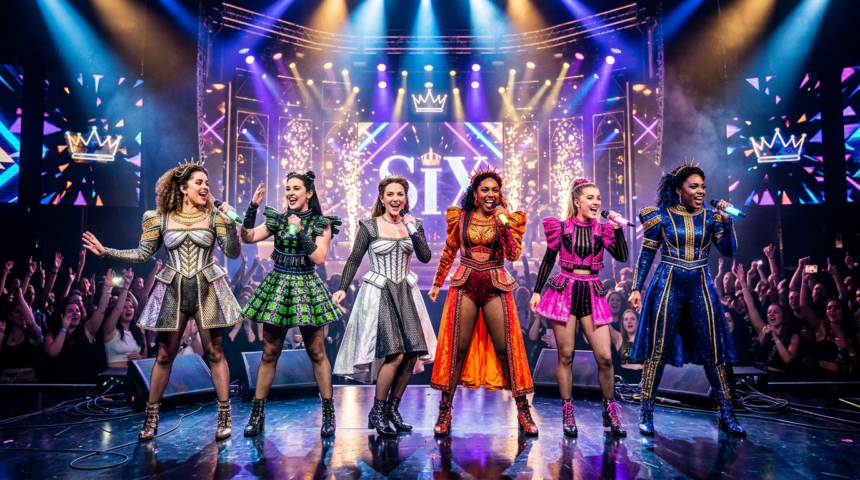
Toby Marlow and Lucy Moss turn a violent chapter of English history into a song contest in Six, a musical led by Henry VIII’s wives.
The show places Catherine of Aragon, Anne Boleyn, Jane Seymour, Anna of Cleves, Katherine Howard and Catherine Parr onstage together. Each queen competes to prove that she suffered most during her marriage to the Tudor king.
That playful contest gives the production a clear dramatic frame. It also lets the women tell stories often reduced to one familiar rhyme: “divorced, beheaded, died; divorced, beheaded, survived.”
A Concert Rewrites Court History
Six presents its story as a modern pop concert rather than a traditional historical drama. The queens address the audience, sing solo numbers and challenge one another’s claims.
Henry VIII remains central to their histories, but he does not control the stage. The musical shifts attention from the king’s decisions to the experiences of the women affected by them.
The six marriages ended in sharply different ways:
- Catherine of Aragon’s marriage was annulled after a long political and religious dispute.
- Anne Boleyn and Katherine Howard were executed.
- Jane Seymour died soon after childbirth.
- Anna of Cleves agreed to an annulment and retained status at court.
- Catherine Parr survived Henry and later remarried.
The competition format initially measures each life through pain. Yet that structure also exposes a problem: ranking the queens by their suffering still defines them through Henry.
From Student Production to Global Hit
Marlow and Moss developed the musical while studying at the University of Cambridge. It was first presented at the Edinburgh Festival Fringe in 2017.
The production later moved into commercial theaters and gained large audiences in London’s West End and on Broadway. Its short running time, concert staging and pop score helped make it accessible to younger theatergoers.
The show’s rise also reflects demand for historical stories told from overlooked viewpoints. Rather than treating the queens as supporting figures, Six gives each one a distinct musical identity and public voice.
Entertainment Meets Historical Debate
The musical does not present itself as a documentary. It compresses events, uses modern language and draws on pop-star styles that did not exist in Tudor England.
Those choices can simplify complicated lives. The queens held different levels of wealth, influence and security. Their marriages were also tied to succession, diplomacy and England’s break with Rome.
Still, the production uses those liberties for a clear purpose. Familiar historical labels become subjects for debate, while humor provides an entry point into abuse, execution, childbirth and political control.
The central contest asks which queen endured the greatest hardship, before challenging the idea that their value should depend on suffering.
This shift is the musical’s main argument. The women begin by competing for attention, but gradually question the terms of the contest itself. Their shared performance replaces a hierarchy of trauma with collective authorship.
A Different Measure of Survival
Six succeeds by balancing spectacle with a direct critique of historical storytelling. Its pop format may not satisfy audiences seeking strict accuracy, but it invites wider interest in the real queens.
The musical’s lasting relevance will depend on that balance. Its strongest message is not that history can be reduced to catchy songs. It is that familiar accounts can change when the people pushed aside are allowed to lead them.