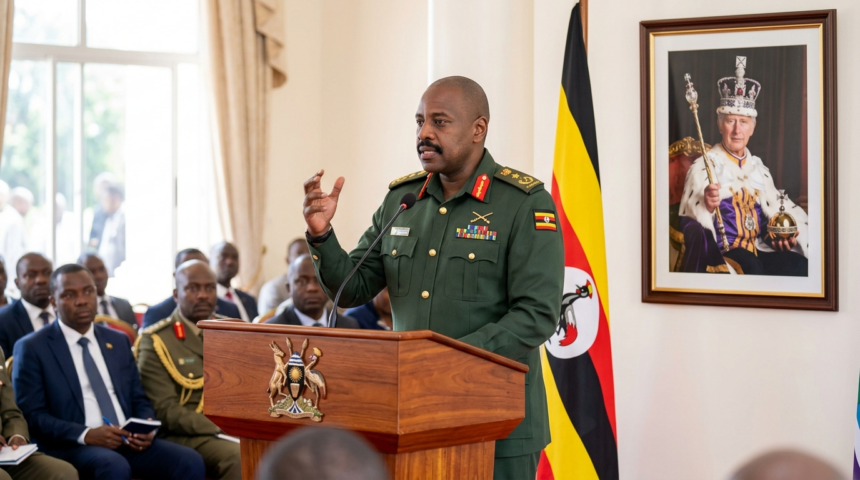
Ugandan General Muhoozi Kainerugaba has said his country would not attend an unspecified event without approval from Charles, while also attacking Prince Harry and Meghan, Duchess of Sussex.
The statement linked Uganda’s possible participation to Charles, although it did not identify the event, explain the approval process, or clarify whether Charles meant King Charles III. Those missing details limit firm conclusions about Uganda’s official position.
Kainerugaba Targets Harry and Meghan
Kainerugaba said he felt motivated to stop what he called “that Harry-Meghan nonsense.” The remark offered no explanation of what activity he opposed or how the royal couple was connected to the event.
Uganda would not participate in any event without approval from Charles.
The wording places royal approval at the center of Uganda’s participation. However, no evidence was provided that King Charles had requested such authority or was involved in any decision.
The statement also leaves several key questions unanswered:
- Which event was Kainerugaba discussing?
- Was he speaking for Uganda’s government?
- Did “Charles” refer to King Charles III?
- What role, if any, did Harry and Meghan have?
A Senior Figure With Political Weight
Kainerugaba is a senior Ugandan military figure and the son of President Yoweri Museveni. His public comments often attract attention because of his rank, family ties, and influence in national affairs.
That status gives his words political weight. Yet a senior official’s statement does not always amount to a formal government decision. An official policy would usually require confirmation from Uganda’s presidency, foreign ministry, or another authorized body.
The reference to Charles also carries historical importance. Uganda was under British colonial rule before gaining independence in 1962. It later became a republic but remained a member of the Commonwealth, an association headed by King Charles III.
The Commonwealth role does not give the British monarch direct authority over Uganda’s foreign policy. Uganda is a sovereign state, and its leaders control decisions about diplomatic or ceremonial participation.
Royal Dispute Enters Diplomatic Rhetoric
Harry and Meghan stepped back as senior working members of Britain’s royal family in 2020. Their departure, media appearances, and criticism of royal institutions have since produced sharp public debate.
Kainerugaba’s language draws that dispute into an African political setting. It also risks mixing personal views about the Sussexes with questions of state representation and Uganda’s relationship with the monarchy.
Supporters may view the remark as a show of loyalty to King Charles. Critics may question why the approval of a foreign monarch would appear necessary for an independent African nation’s attendance at any event.
For now, the statement is more provocative than conclusive. Its practical meaning depends on confirmation from Ugandan authorities and identification of the event involved. Further clarification will determine whether the remarks signal policy, personal opinion, or political theater.