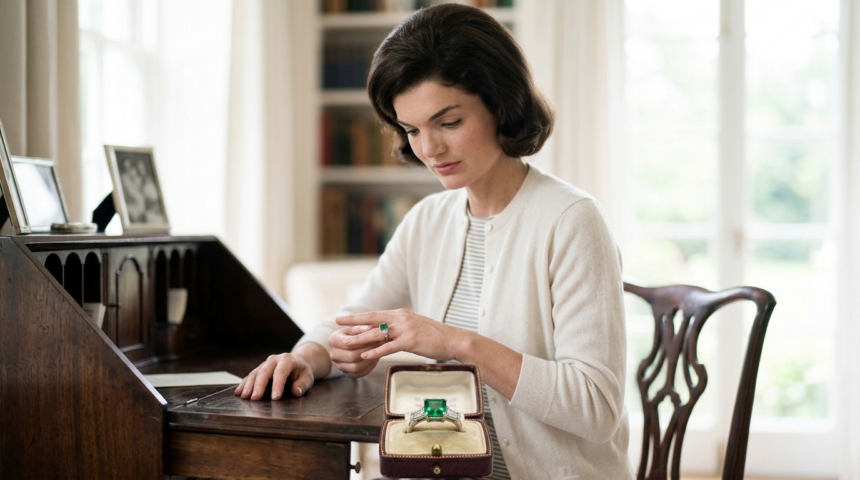
John F. Kennedy proposed to Jacqueline Bouvier in 1953 with an emerald-and-diamond ring that later received a striking personal redesign.
The ring used the French toi et moi style, meaning “you and me.” Its paired gemstones reflected two people joined together. Kennedy’s choice also stood apart from the diamond solitaire rings common among American brides at the time.
A Proposal Before the White House
Kennedy and Bouvier moved in similar social circles before becoming engaged. He was a young U.S. senator from Massachusetts, while she worked as a photographer and reporter in Washington.
Kennedy proposed in 1953, eight years before he entered the White House. The couple married that September in Newport, Rhode Island.
The engagement ring came from Van Cleef & Arpels. It paired an emerald weighing about 2.84 carats with a diamond of roughly 2.88 carats. Baguette-cut stones provided additional decoration.
The toi et moi design joined two main gemstones in one setting, a visual symbol of partnership.
The style had deep European roots. Napoleon Bonaparte helped popularize it in 1796 when he gave Joséphine de Beauharnais a ring with two stones set side by side. The design returned to public attention through later royal and celebrity engagements.
Emerald Choice Broke With Convention
The emerald gave Jacqueline Kennedy’s ring a distinct identity. Mid-century American engagement jewelry often centered on a single white diamond. Colored stones were less typical for prominent political couples.
Emeralds also require more care than diamonds. They rank lower on the Mohs hardness scale and often contain natural internal features. Those traits can make them more vulnerable to impact, heat and harsh cleaning.
Still, the vivid green stone offered strong visual contrast with the diamond. That pairing made the ring easy to recognize and linked it to Jacqueline Kennedy’s reputation for selective, personal style.
The 1962 Redesign Added Movement
Jacqueline Kennedy changed the ring in 1962, while serving as first lady. The original baguette accents were replaced with round and marquise-cut diamonds totaling about 2.12 carats.
The new stones formed a more organic setting around the emerald and main diamond. Marquise cuts resembled leaves, while round stones softened the ring’s lines. The revision created a floral or wreath-like effect.
Key elements changed in the redesign:
- The emerald and main diamond remained the central pair.
- The straight baguette accents were removed.
- Round and marquise diamonds added texture and motion.
- The symbolic two-stone structure stayed intact.
No single documented statement fully explains her reason for altering it. The redesign, however, matched her growing preference for sculptural jewelry and showed that an engagement ring could change with its owner.
A Lasting Influence on Engagement Jewelry
The ring remains one of the best-known political engagement jewels in the United States. Its appeal rests on both its presidential history and its unusual mix of color, symbolism and customization.
Modern jewelers have again promoted two-stone rings, sometimes using different gems to represent each partner. Recent celebrity proposals have also renewed interest in the form.
Jacqueline Kennedy’s redesign adds another lesson to the ring’s history. Sentimental jewelry need not remain frozen in its original setting. Its central meaning can survive even when its appearance changes.
More than seven decades after the proposal, the ring still reflects two stages of Jacqueline Kennedy’s life. The first setting marked an engagement. The second asserted her own taste, while preserving the paired stones at the heart of the design.